Posted on 1 Comment

New cow arrived with a highly contagious infection, here’s what happened…

In this post you’ll learn all about pink eye in cattle, how to recognize it, how to treat it naturally and how to hopefully prevent it from occurring in the first place. We share the full story below of how we went from very distraught about the potential damage to our entire herd to thinking about pink eye holistically.


This summer Mint Leaf joined our herd temporarily – our goal is to train her be a family milk cow before she goes on to her new home after calving next year. When she arrived she was mostly unhandled, and ran the other way whenever we came too close for her comfort. Whew!

Mint Leaf and her yearling bull calf on the day they arrived to our farm

After Mint Leaf’s arrival we realized something was going on with her eyes – we saw white spots near the center of each of her eyes. We reached out to her previous owner and learned that those were scars from a her having pink eye previously. But over the next couple days we saw one spot seemed to be getting bigger and her whole right eye was turning cloudy looking. We gathered and prepared natural remedies for pink eye (more details on those in a bit) and began to attempt to treat her eyes.

If you search the web for information on pink eye in cattle, you’ll discover that it is reported to be caused by a bacteria that is easily transferred from cow to cow by flies that congregate around the cows’ eyes. You’ll also likely be met with an overwhelming number of pages that say it is highly contagious and can lead to blindness!

We contacted our vet to ask her opinion, and she said besides the cloudiness to the eye to look for watery discharge and squinting in the sun to help determine if it was an active infection. We never saw her squint in the sun, so maybe our treatment stopped it from reaching that stage!

For several days we kept a close watch on all of our other cows’ eyes, worried that we may have a herd outbreak. Thankfully none of the other cows developed any noticeable symptoms other than a slightly watery eye here and there. This experience was another powerful example to us of how “terrain” is more important than the mere presence of “germs.”

What do I mean by that? We figured out that the reason Mint Leaf developed this infection while none of our cows did is likely because our cows are given free choice minerals, specifically kelp and the iodine it contains protect against pink eye infection even in the presence of the bacteria that causes the infection. (During the first few days that Mint Leaf and her calf were here they went through an entire salt mineral block between the two of them – pointing to a definite need for more minerals in their bodies!)

This is the closest we could get to Mint Leaf before she would take off in the other direction when she first came to our farm
Mint Leaf in the corral we set up to treat her

At first we were not able to adequately treat Mint Leaf’s eyes with her being so skittish of us – we snuck in a few sprays as she ate a treat (molasses and alfalfa) but she was on to us quickly and would not let us get close enough to help her after a few treatments. We knew we needed a better plan ASAP so we set up a small corral with cattle panels adjacent to the cows’ current paddock in their rotational grazing. Then we let our cows lead the way in, with Mint Leaf following closely behind – they are herd animals and we took advantage of this! Once everyone was in the corral we led our cows back out and Mint Leaf was contained. So simple and no stress.

We started drenching Mint Leaf’s eyes at least twice a day with a recipe we made from essential oils, an eye bright tincture and colloidal silver. We switched from a spray bottle to a squirt bottle so we could more thoroughly drench her eyes. One person held her head close to their body while the other held her eye open and saturated it with the mixture. Cows can squeeze their eyes very tightly shut so you have to be very firm! We also gave her kelp, Vitamin A (which can become depleted during infection), selenium, Redmond salt and a daily dose of the immune supporting recipe we use for cattle (all of the details of these natural remedies are in our Holistic Homestead Course). Mint Leaf happily gulped down all the vitamins and minerals we provided her and I refilled them multiple times per day to help her body heal.

When our vet came out to look over Mint Leaf, we learned that pink eye starts out all over the eye, and then as the healing process begins the body concentrates the infection into the pink area you see in the photo above.

The pink area gets smaller and smaller until it’s cleared up and it can take a month or more for the pink to disappear. This area of concentration often protrudes from the surface of the eye and will likely have white scar tissue long term from the pressure there. Usually the cow will be able to see well enough but may have some areas of dark or lost vision.

Mint Leaf back on pasture

Despite Mint Leaf really disliking her eyes being treated, we were able to take advantage of the time we had her corralled to get a halter on her, brush her all over (cows LOVE brushing) and we each brought her handfuls of her favorite plants from the pasture every day (along with the hay she had in the corral) so that she learned to eat out of our hands and not fear us.

We put Mint Leaf back on pasture as soon as she was friendly enough for us to catch her and continue treating her eyes. Now we can walk up to her and give her scratches almost as easily as all of our other cows!
Posted on

Monthly News July 2023

July 7, 2023

It’s July! And my last update was in March! Typical that spring and summer tend to get busy on the farm! Over the last few months we have made a number of changes around our farm, and we are refocusing on our primary purpose of our homestead (other than feeding ourselves), which is to empower other families to holistically raise their own food too! What does that mean we’ve changed? We’re taking a break from selling food from our farm, and we’re focusing more on raising animals for other families as well as education on homesteading holistically through our blog and course.

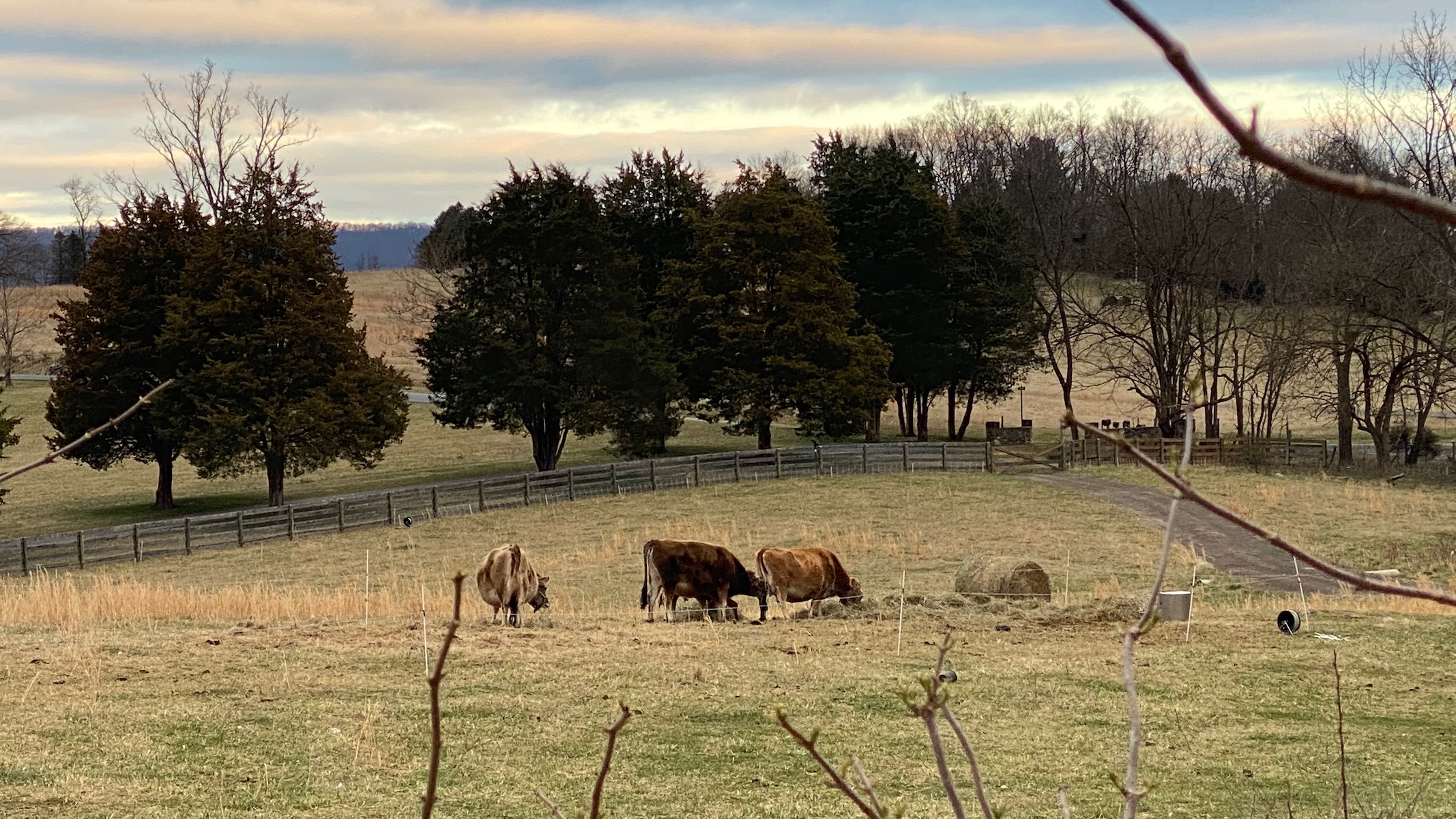
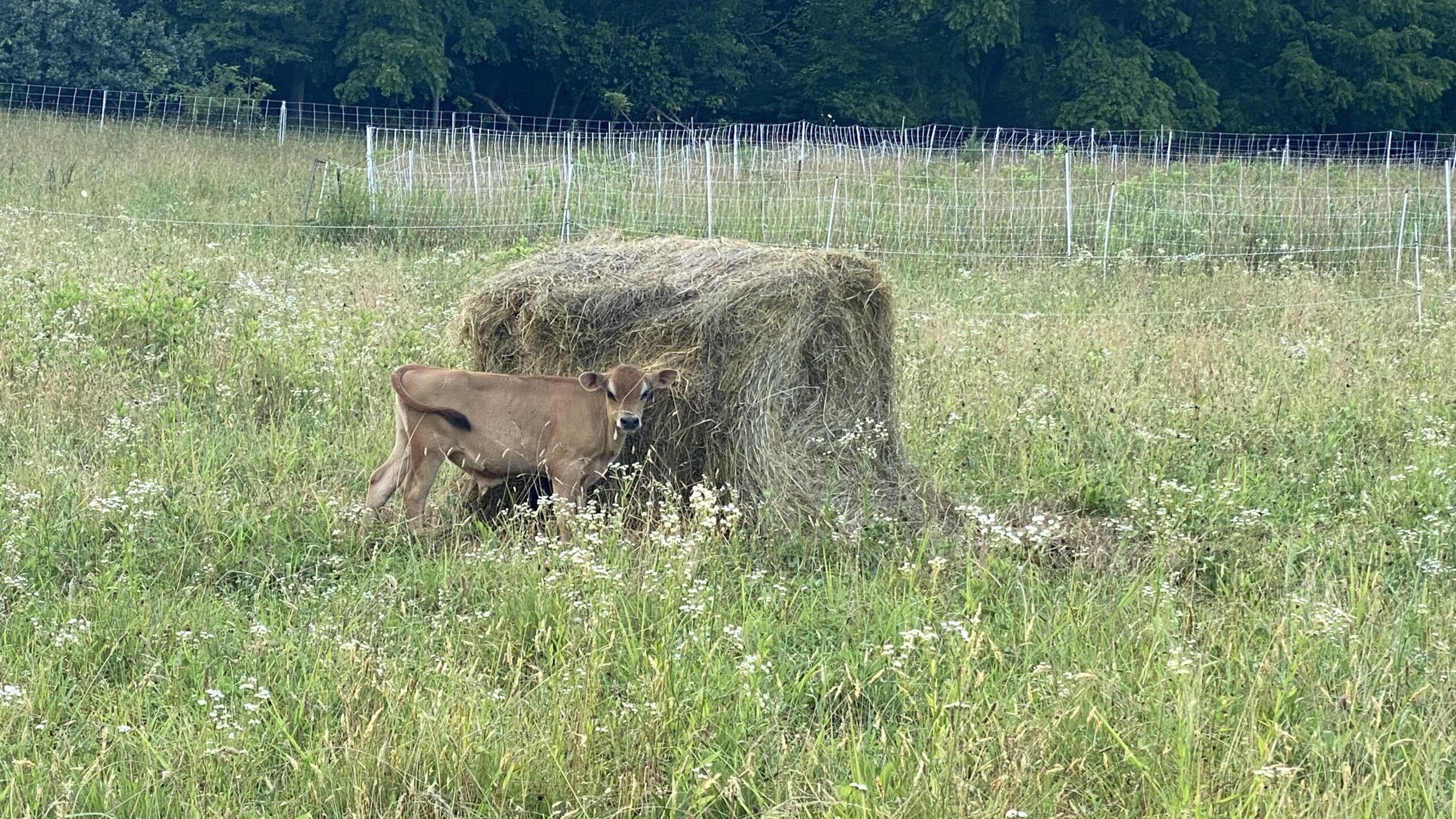
Since my last update, we and all the animals made it through a two month drought: just take a look at the photo above for proof – much of our pasture is thin and weedy and we’ve been feeding hay all summer to make sure the cows get the nutrition they need! We’ve had a bull calf born and we bought a heifer calf from an organic grass-fed dairy farm (both will be available to go to new homesteads when they are old enough). We temporarily added two more cows to our herd (more on that below). And we purchased three new unrelated rams to create three sheep breeding groups that will allow other families who purchase from us to be able to buy breeding pairs and trios. We have also completed another hatching egg season and I’m hopeful to get a fall garden started within the next month!

A lot of our focus this year is training future family milk cows. Besides the calf we have been working with since her first week of life we are also taking on a challenge (at least for us!) – we’re boarding a cow who has not been trained. Our mission is to train her to be a family milk cow before she goes to her new owners next year. This is the first time we’ve taken on a fully grown cow who hasn’t already been halter and lead trained and we’ll also watch her through calving and get her started with being milked. So far she’s fitting in well with our herd and we’re slowly working on her warming up to humans. We also have her yearling bull calf here to breed our two oldest cows for next year’s calves.

One last thing I’ll mention – a project that is coming together nicely is our chicken breeding project! We have kept many rare and heritage breeds here on our farm and I never could pick just one favorite breed so I started working a couple of years ago with combining some of my favorite birds. Some of the most important traits I’m looking for are that they are excellent foragers and do not have single combs (to avoid roosters with frostbite). Of course we also love beautiful feathers and eggs so many of the birds are blue and splash with slate legs, and beautiful chocolate eyes and some have copper patterns in their feathers. Most of the birds lay seafoam colored eggshells and some lay brown with light speckles. They are truly fun and beautiful birds and eggs and I can’t wait to share them with you in the future!

I hope you are having a great summer!

XO Sarah

Latest Pages

There are a number of new pages on our website, including photos and information about our breeding cows and sheep:

My Favorite Scent of Summer – Seaside!

We don’t live close to the ocean anymore, but I still get to experience the smell of the seaside in our home on summer days.

Would you like to try it too? You can order a set of three summer scents, or just pick your favorite. The summer Simplified Collection includes Seaside, Orange Creamsicle and Tropical Tango.

You can use these blends in a diffuser, in place of perfume, to make a room spray and more.

If you’ve never ordered from Young Living before and don’t have a diffuser, let me know and I’ll send you a free diffuser when you order the Simplified Summer Collection! You can also get 10% off your first order with the code SHAREYL.

Posted on Leave a comment

Packing Hatching Eggs

Q: “Would it be in the scope of this course to show how you pack the eggs to ship? I’ve received eggs from several people over the years but I noticed yours are the most well- packed and eco-friendly!”

A: I received this request to share how I pack hatching eggs in the course forum, but I thought I would share on the blog for hatching egg customers to see too!

Feel free to ask any follow up questions in the comments.

Posted on 2 Comments

We thought we were going to lose her

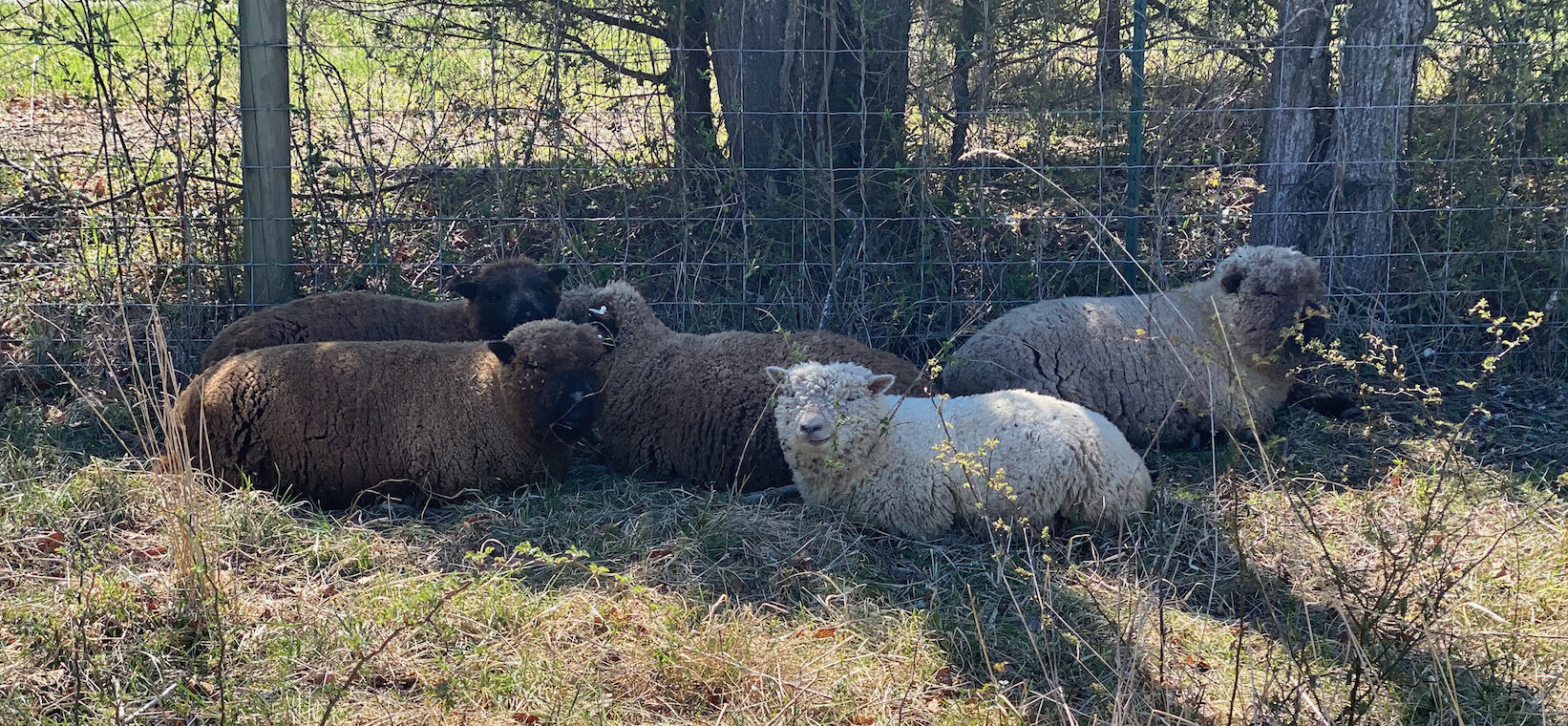
Ewes chewing their cuds

The ewe in this story is the white one at the front of the photo. The photo was taken the day after the big scare, she was back to calmly chewing her cud with the rest of the flock.

Just three days before the first birthday of our ewe Stellaria, Peter came in from refilling waterers at nearly 9pm and told me she was making a funny coughing sound.

The way he was mimicking the sound, I thought maybe it was one they sometimes make when bringing up their cud but he felt something was off since she was hanging back from the flock, not interested in the water, not grazing and not chewing her cud. He asked me to go see what I thought.

The ewes were all the way on the other side of our property. As I approached (even in the dark) I could tell something was very wrong. She was no longer making any noise but was struggling to breathe, breathing rapidly with her mouth open and her tongue hanging out with foam all around her mouth. My first thought was choking. The energizer wire had broken in the morning and some of our ewes got out. Was it something she got into? But why was she fine all day only to have it effect her 12 hours later if that were the case?

There’s no cell service where the ewes were so I ran back to the house and had the big kids come help me see if we could see anything in her throat. (We couldn’t.) We felt helpless since we had no idea what was causing this severe breathing distress and scared we were going to lose her since we weren’t sure how much time we had to help her. 

We ran back toward the house again and called a friend while waiting for the vet to return our call. Both our friend and the vet suspected pneumonia and helped us rule out other possibilities. Then we went to take her temperature to confirm. A normal temperature in sheep is 102-102.5. The vet said if she was 104 go ahead and try our natural remedies but if she was 105+ she thought we should come pick up injectable medications right away. We took her temp and it was 106.2! ????

We gave her the natural remedies we had on hand (essential oils for immune support, fever support and respiratory support, ionic minerals, probiotics, and fruit puree for anti-oxidant and anti-inflammatory immune support) and then Peter took off to pick up the injections. My reference book says pneumonia in sheep and goats causes lesions on the lungs, which would explain why she was struggling to breathe.

By the time Peter got back with the medications and we went to check on her status it was immediately noticeable that she had improved significantly. She was still breathing somewhat rapidly but she looked much calmer and was able to breathe with her mouth shut. We took her temp and it was down to 104! Since she made such a rapid improvement we held off on giving her the injections. 

By morning she was back to breathing normally and grazing with the flock when we checked on her. We didn’t catch her on our first try and she briefly started wheezing when she ran from us but recovered quickly. Her temp was down to 102.7. We gave her the natural remedies again, and will continue giving them twice a day for at least four days as our vet suggested. 

I thank the Lord that Peter went to the sheep that night or she may not have made it through the night. We’ve never had an experience like this before but this is exactly why I think it’s so important to have a relationship with a vet! She helps us diagnose anything that we can’t figure out on our own, and we can then treat accordingly. Our natural remedies have always worked so far!

We also learned how to tell the difference between a sheep that is choking and a sheep in respiratory distress from pneumonia. We also know to keep an eye out for pneumonia in the spring when the weather is up and down (we’ve had a lot of warm sunny days with cold, windy and rainy nights recently.)

Note on choking:

  • It’s rare for a sheep to choke on anything other than grains (they don’t make enough saliva to eat grains without a risk of choking)
  • A sheep that is choking will be very obviously trying to dislodge the blockage: stretching out her neck, swinging her head around etc

Want to learn more about the natural remedies we use? Learn all about natural sheep care in the Holistic Homestead Course!

Posted on

It’s time to wean this bull

We had two calves born in late 2021, and our original plan was to have them nurse for at least 6 months, while sharing the milk with us. We let the calves have all the milk over the winter, so we could take a break from milking during the cold weather. In the spring of 2022 we began separating the calves from their dams first thing in the morning, milking in the evening and then reuniting the calves and cows overnight.

As Orion approached the 6 month mark, his dam (Mulberry) was losing condition (getting too thin) so we decided to separate her indefinitely and milk her once per day while working on getting her weight up a bit. We put Orion in with the other cow (Moonbeam) and her heifer calf (Starlight). 

We expected Orion would try to nurse Moonbeam, but we weren’t sure if she would allow it. Since he was just a week or so shy of 6 months old, we were okay with him weaning if that happened. Moonbeam went on to nurse him, while still nursing her own calf, and a couple of months later we borrowed a bull so she was also pregnant again while nursing these two large calves. We were very impressed with her ability to hold her condition through it all!

Moonbeam with Starlight (13 months) and Orion (11 months)

Fast forward to the spring of 2023 and it’s time to wean the bull! Moonbeam was able to wean her own calf Starlight when she was around 15 months old, but Orion persisted in nursing longer. He is now 15 months old as well.

Weaning a calf and drying off a cow don’t typically occur simultaneously, but when a 15 month old bull is nursing, and the cow is approaching the last two months of her current pregnancy, time is of the essence! Ideally, we want to give the cow a break from lactating and we want to make sure her next calf is not competing with a much larger animal for the colostrum that is crucial for its survival.

Fence Line Weaning Method

We used the “fence line weaning” method, meaning that the calf is on the other side of a shared fence from the cow. We used two hot wires – one at a height to prevent nursing and the other at a height to prevent him stepping over into the cow’s paddock. In our experience, all the cows are much more at ease with separation when they are near each other and can even continue to have physical contact with each other over the fence (like in the video below).

Moonbeam and Orion at the shared fence line

Drying Off

Since we hadn’t been milking Moonbeam for several months before starting the weaning/drying off process, I wasn’t sure how much milk she was currently making.

After 24 hours I checked her udder visually to get an idea of how much milk appeared to be building up. It was getting fuller but was not uncomfortably tight from what I could see.

After 48 hours I set her up for milking as her udder was becoming tight all over. She carries her milk high, and at that point it looked full all over and her highest producing quarter felt like it had a clogged duct (but was not hot, which would indicate infection).

I massaged her udder and milked 1/2 gallon to relieve the pressure, but left plenty of milk behind. The more milk you take out the more milk the cow’s body will continue to make. Decreasing demand tells her body to slow down production. In the past I’ve done a much slower drying off (which I preferred and felt was less of a shock to the cow) but we started closer to calving this time and went faster.

I kept an eye on her and the clogged duct and milked again another 48 hours later; this time less than 1 quart, just enough for the udder to feel a little softer. The clogged duct is still there but softer and still not hot. Overall her udder is much less tight and I don’t think she needs to be milked again but I will keep an eye on her and relieve pressure only if necessary until she’s dried off. We won’t have the bull in with her again until her nursing relationship with her new calf is well established and we’re ready for her to become pregnant again!

Discussion

If you have anything to add to this topic or questions you’d like to ask, we have a discussion on this topic in the Holistic Homestead Course Forum!