Posted on Leave a comment

A simple but important skill to ensure your sheep are healthy

Babydoll ewe lambs ready to head to their new home

This weekend a couple of lambs born from our flock went to their new home, and while their new owners were here for pick up, I quickly showed them a simple skill that makes a huge difference in monitoring the health of lambs. It can be used with sheep of all ages, but is especially important for growing lambs and lactating ewes.

So what did I show them? It’s called FAMACHA scoring. The FAMACHA scale allows you to monitor your sheep for internal parasites and catch any changes early on, so you can focus on preventative care and use natural support for any sheep that are showing early signs of a parasite load, typically before you see more obvious signs such as weight loss.

What is FAMACHA?

The score is used because it indicates the level of anemia in sheep caused by blood-feeding parasites. By looking at the color of the sheep’s lower eyelid membrane (inside their eye), you can estimate how much of a parasite load she is carrying.

scoring your sheep

ScoreAnemia StatusAction
1No anaemiaNo deworming, monitor
2Acceptable, mild anaemiaUsually no deworming, recheck soon
3BorderlineDeworm young, thin, pregnant, or if many in your flock score 3
4Moderate anaemia, immediate attention neededDeworm, support red blood cells, monitor recovery
5Severe anaemia, critical attention neededDeworm urgently, support red blood cells, contact vet
Rough idea of colors in the FAMACHA score card

How to Check Your Sheep

Checking only takes a few seconds and most of our sheep are very used to it and don’t “bat an eye” when we check them:

  1. Hold your sheep’s head steady in one hand and gently push down with the thumb of your other hand below the eye, on the lower lid. You’ll see the lower lid turn out a bit and that will expose the mucous membrane.
  2. Look at the color of the inner eyelid for red or dark pink. If you see pale pink or white, that sheep needs your help right away. You can get a FAMACHA chart to compare the colors.*
  3. If you check your lambs weekly during the growing season, you should have plenty of time to help turn things around as soon as you see their color lighten.

*The chart above is a rough idea of coloring; if you want to do more formal scoring you can purchase (copyrighted) scoring cards and take a course for training in FAMACHA scoring.

Holistic Management

On our homestead, we don’t just monitor for parasites, we actively work to create an environment where parasites can’t thrive.

  • Multi-species rotational grazing: Moving animals away from an area where they have grazed (and pooped!) and giving that area a rest period means that the parasite eggs that hatch from the manure in that area will not find their way back into another sheep. Even better if a different species grazes that area before any sheep return, since internal parasites are generally species specific and they meet a dead end if ingested by a chicken or cattle.
  • Species appropriate nutrition: Sheep who are eating high-quality forage, drinking clean water, eating natural minerals and vitamins (like those found in kelp) are more able to handle a low-level parasite load without any ill effects.
  • Breeding goals and culling: This can be a hard one to face, especially when you have just a few beloved animals, but keep in mind that what you breed, you get more of. If an animal is consistently struggling with parasites despite your best efforts at good management, ideally you should not breed that animal.

What to expect

Don’t be discouraged if you see a range of scores in your flock. Each sheep has an individual makeup but by incorporating FAMACHA scoring into your weekly routine, you can shift from risking reacting to a problem that’s far along, to proactively stopping parasites before they become a serious concern. Your careful observation of your sheep is the most important part of keeping them well and making your homestead a success. I hope you found this helpful, and that you will add checking FAMACHA scores to your weekly chores!

Learn More

Learn more About Our Sheep here and everything you need to know to raise Babydoll sheep holistically here: The Holistic Homestead Course.

Posted on 4 Comments

What is the true cost of pastured lamb?

Many years ago, our family switched from purchasing our meat from the local grocery store to a family farm in Pennsylvania. The family we purchased from raised animals for milk and meat (and partnered with other local families raising eggs and other animal species for meat). They sold to a NYC buying club and those of us in NYC who wanted pasture raised, organic, soy-free, corn-free milk, meat and eggs would put in our orders and then meet a van at a restaurant that volunteered it’s space for unloading and distributing the food. Members would take turns unloading and being the person in charge of checking orders and collecting payment. It was a fantastic model for city residents to get healthy food from small farms that they could visit and even have a say in how things were done! (For eg one year as costs were rising we voted on whether to pay more for our food or for the farmer to start including some organic corn in the animals’ diets. We voted to pay more!)

The prices on food of this quality may shock those of us who have never purchased meat other than what is available at a grocery store. Most meat at grocery stores comes from animals raised in crowded, unsanitary conditions, fed things that aren’t food by any stretch of the imagination.1,2 They’re given antibiotics to keep them alive in terrible conditions and on and on. The system they are raised in is designed to grow the most meat in the least space with the least cost possible. The wellbeing of the animals and the healthfulness of the resulting food that consumers purchase and eat is not a focus of this system.

Our family was inspired by farmers like the families we purchased our meat and eggs from when we lived in NYC. They were a big part of us deciding to make a change and start raising our own food. Today I’ll talk about how we raise sheep, and what our cost of raising lambs for meat is in West Virginia. I hope this will help you have an appreciation for the price tag when you see pasture raised lamb meat for sale from a family farm! As I’m writing this, two other farmers are writing about their cost for raising pastured poultry and beef on their farms. I’ll share those links in the comments as soon as they are ready!

Assumptions

  • Fencing, shelter, waterers and mineral feeders etc are already purchased (up front cost are NOT included in the cost breakdown)
  • The lambs are born to the existing flock on the farm (cost of purchasing lambs is NOT included)
  • Time is paid at the West Virginia minimum wage of $8.75 per hour
  • A truck, trailer etc to transport the lambs to a local humane USDA approved butcher is already owned (cost of transport equipment is NOT included)
  • Each lamb yields approximately 50 pounds of meat at 1 year old or 35 pounds of meat at 8 months old
  • There are zero losses, which on our farm is possible with the protection of livestock guardian dogs (cost of feeding a guardian dog is NOT included)
  • Time monitoring ewes during labor, assisting lambing, or supporting weak lambs is NOT included

Method

  • Lambs are raised with their mothers until weaning, on pasture, and rotationally grazed through the fall. They eat a variety of plants, run and play together in the field, rest in the shade and maybe even accept hugs and massages from the farmers during daily checks
  • Lambs are fed hay during the dormant season, still have access to pasture (a winter paddock) for fresh air and space to move around, but also have shelter to get out of freezing rain etc
  • Minerals are provided free choice
  • Natural dewormer (essential oils) are used weekly to ensure parasites aren’t inhibiting the lambs’ growth
  • Lambs are butchered at 12 months old, or at 8 months old (at the end of the growing season) in a facility that allows them to rest and calm down overnight after travel, as well as using the moving methods of Temple Grandin to keep them calm leading up to their death

Costs

April through November (35 weeks):

  • 15 minutes per day bringing water and checking minerals, observing lambs for any problems that may arise = 0.25 hours x 7 days x 35 weeks x $8.75 = $535.94
  • 30 minutes per week moving portable fencing and shade/shelter, administering dewormer = 0.5 hours x 35 weeks x 8.75 = $153.13

December through March (17 weeks):

  • Hay is fed at 5 pounds per lamb per day, a 45 pound bale costs $5 each = $5 x 7 days x 17 weeks  = $595
  • 15 minutes per day bringing water and hay, checking minerals, observing lambs for any problems that may arise = 0.25 hours x 7 days x 17 weeks x $8.75 = $260.31

Minerals and deworming

  • 1 bag of Thorvin kelp = $89.50
  • 2 bags of Redmond salt = $43.90
  • ParaGize EO (x2 bottles) = $25

Butchering

  • 1 hour loading and traveling to and from butcher = $8.75
  • Butcher fee, including parsing, bagging, weighing and labeling = $125 per lamb x 9 lambs = $1,125
  • 9 lambs x 50 pounds = 450 pounds

Total cost

$2836.53 / 450 pounds = $6.30 per pound

Other Examples

How does the cost change if you butcher at the end of November for approximately 35 pounds of meat per lamb and no winter cost? What if you only have 4 lambs to raise? Here’s a chart with four scenarios and the cost per pound:


9 lambs,  1 year old9 lambs,  8 months old4 lambs,  1 year old4 lambs,  8 months old
April-Nov hauling watering, minerals, daily check$535.94$535.94$535.94$535.94
April-Nov weekly moving fence/deworming$153.13$153.13$102.08$102.08
Dec-March hay purchase$595.00$0.00$264.44$0.00
Dec-March hauling water, hay, minerals, daily check$260.31$0.00$260.31$0.00
Thorvin kelp$89.50$89.50$89.50$89.50
Redmond salt ($21.95 each)$43.90$43.90$21.95$21.95
ParaGize ($12.50 each)$25.00$25.00$12.50$12.50
Load and travel to butcher$8.75$8.75$8.75$8.75
Butcher fee ($125 per lamb)$1125.00$1125.00$500.00$500.00
Meat yield (50 per lamb at 1 year, 35 per lamb at 8 months)450 pounds315 pounds200 pounds140 pounds
Total Cost$2836.53$1981.22$1795.47$1270.72
Cost Per Pound$6.30$6.29$8.98$9.08

If we were to sell our lamb meat at cost, would you think those prices are fair for the work put in and the quality of the meat? How much of a profit should a farmer make? One of the reasons we don’t sell much of the food we grow is that we can earn a lot more money per hour doing other work; so we raise animals for our own consumption. If all of us consider the effort of the farmers we purchase from, and gladly pay the prices that keep them in business I think it would contribute significantly to a better future for animals, farmers and consumers! What do you think? Where do you typically get your meat? How do you decide how much it’s worth to you per pound? I’d love to hear your thoughts in the comments.

Posted on 2 Comments

We thought we were going to lose her

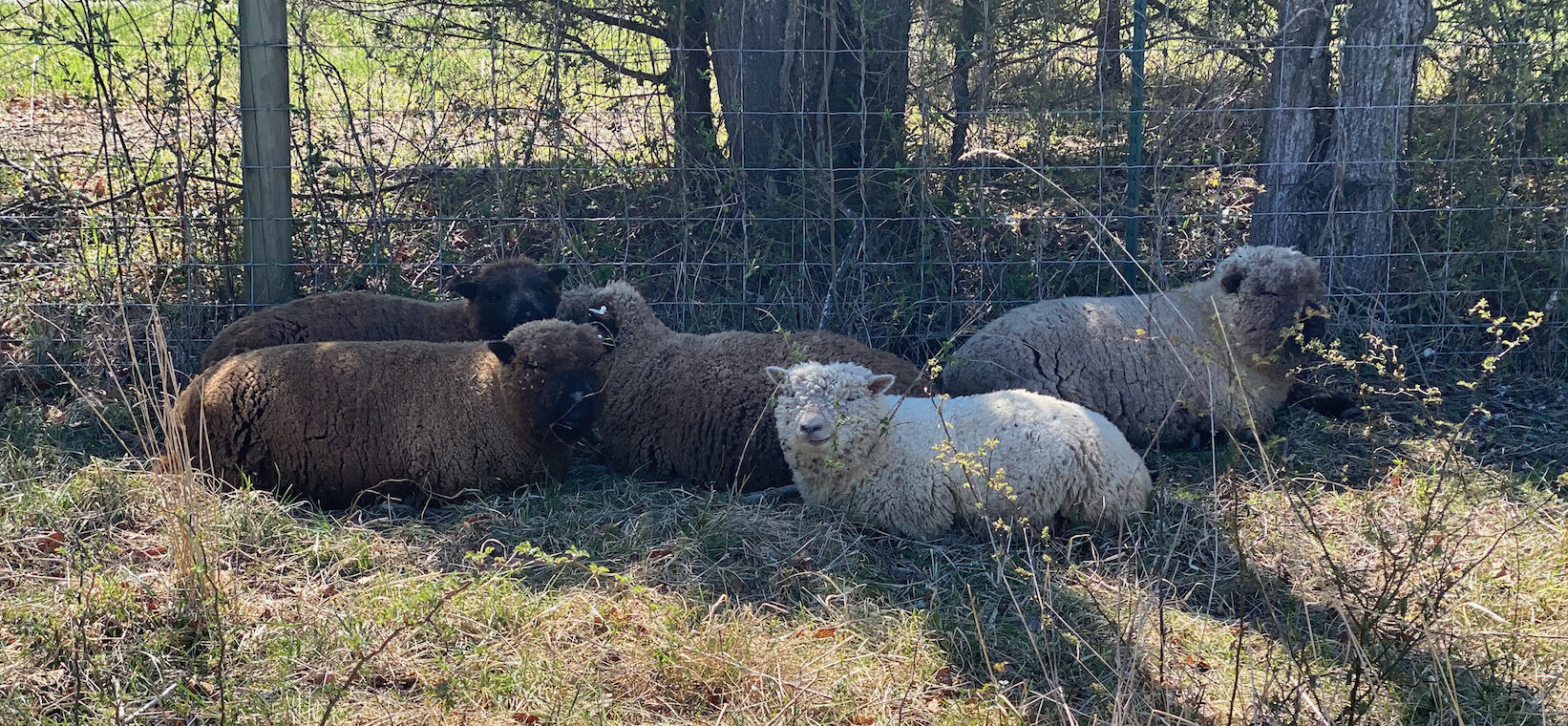
Ewes chewing their cuds

The ewe in this story is the white one at the front of the photo. The photo was taken the day after the big scare, she was back to calmly chewing her cud with the rest of the flock.

Just three days before the first birthday of our ewe Stellaria, Peter came in from refilling waterers at nearly 9pm and told me she was making a funny coughing sound.

The way he was mimicking the sound, I thought maybe it was one they sometimes make when bringing up their cud but he felt something was off since she was hanging back from the flock, not interested in the water, not grazing and not chewing her cud. He asked me to go see what I thought.

The ewes were all the way on the other side of our property. As I approached (even in the dark) I could tell something was very wrong. She was no longer making any noise but was struggling to breathe, breathing rapidly with her mouth open and her tongue hanging out with foam all around her mouth. My first thought was choking. The energizer wire had broken in the morning and some of our ewes got out. Was it something she got into? But why was she fine all day only to have it effect her 12 hours later if that were the case?

There’s no cell service where the ewes were so I ran back to the house and had the big kids come help me see if we could see anything in her throat. (We couldn’t.) We felt helpless since we had no idea what was causing this severe breathing distress and scared we were going to lose her since we weren’t sure how much time we had to help her. 

We ran back toward the house again and called a friend while waiting for the vet to return our call. Both our friend and the vet suspected pneumonia and helped us rule out other possibilities. Then we went to take her temperature to confirm. A normal temperature in sheep is 102-102.5. The vet said if she was 104 go ahead and try our natural remedies but if she was 105+ she thought we should come pick up injectable medications right away. We took her temp and it was 106.2! ????

We gave her the natural remedies we had on hand (essential oils for immune support, fever support and respiratory support, ionic minerals, probiotics, and fruit puree for anti-oxidant and anti-inflammatory immune support) and then Peter took off to pick up the injections. My reference book says pneumonia in sheep and goats causes lesions on the lungs, which would explain why she was struggling to breathe.

By the time Peter got back with the medications and we went to check on her status it was immediately noticeable that she had improved significantly. She was still breathing somewhat rapidly but she looked much calmer and was able to breathe with her mouth shut. We took her temp and it was down to 104! Since she made such a rapid improvement we held off on giving her the injections. 

By morning she was back to breathing normally and grazing with the flock when we checked on her. We didn’t catch her on our first try and she briefly started wheezing when she ran from us but recovered quickly. Her temp was down to 102.7. We gave her the natural remedies again, and will continue giving them twice a day for at least four days as our vet suggested. 

I thank the Lord that Peter went to the sheep that night or she may not have made it through the night. We’ve never had an experience like this before but this is exactly why I think it’s so important to have a relationship with a vet! She helps us diagnose anything that we can’t figure out on our own, and we can then treat accordingly. Our natural remedies have always worked so far!

We also learned how to tell the difference between a sheep that is choking and a sheep in respiratory distress from pneumonia. We also know to keep an eye out for pneumonia in the spring when the weather is up and down (we’ve had a lot of warm sunny days with cold, windy and rainy nights recently.)

Note on choking:

  • It’s rare for a sheep to choke on anything other than grains (they don’t make enough saliva to eat grains without a risk of choking)
  • A sheep that is choking will be very obviously trying to dislodge the blockage: stretching out her neck, swinging her head around etc

Want to learn more about the natural remedies we use? Learn all about natural sheep care in the Holistic Homestead Course!

Posted on Leave a comment

Deworming – not just for livestock!

If you have chickens or any other livestock, I bet you’re familiar with the idea that deworming is beneficial for them (after all they eat off of the ground and seem to love drinking the least fresh water they can find ????)

…but did you know you and your family can benefit as well?

If you’ve ever noticed moods, energy or sleep are thrown off around the full moon – it could be because that’s when parasites are most active. This makes it a great time to support your body in flushing them out!

You can start up to a week before and continue up to a week after the full moon, or you can do just a couple days on either side of the full moon. I’d start with less and increase if you don’t see results.

What do we use and why?

We use Oregano Vitality and Clove Vitality essential oils (plus a couple of bonus options I’ll share at the end).

Oregano Vitality will help to break down the biofilm parasites hide in and support the body’s ability to restore balance by eliminating an abundance of undesirable parasites. Clove Vitality will kill eggs so that new parasites don’t immediately take their place. 

If you’re doing the full two weeks, skip clove on days 1 & 2.

Recipe

  • 2 drops oregano
  • 1 drop clove

For adults:

  • Add oils to a clear veggie capsule and top with carrier oil

For kids:

  • Rub oils on the bottom of their feet at bedtime. Make sure they don’t touch their feet (it can sting if they touch their eyes after).

For animals:

  • Add oils to feed or water.
  • If adding to feed we soak it in water, skimmed milk or whey.
  • If adding to water we also add 1 spray of Thieves cleaner to emulsify (otherwise the oils float on top of the water).

That’s it! Grab your supplies now before the next full moon comes around!

PS If you’re wanting to take it to the next level, ParaFree soft gels are formulated with an advanced blend of some of the strongest essential oils studied for their cleansing abilities! And ParaGize is blended specifically to support your animals’ natural cleansing system. See my Parasite Cleanse and ParaFree highlights for more info.

Posted on Leave a comment

What one supplement do all livestock need?

There’s one supplement we give to every animal on our farm – cows, sheep, poultry, pig and even our guardian dogs!

We give it because of how much it provides in bioavailable minerals, which effect their ability to stay well and thrive in so many ways, especially during our current times of depleted soils making everything growing in them deficient.

So what is it? Kelp, specifically Thorvin kelp.

Here’s some info from the company’s website:

Thorvin is a 100% natural feed supplement for supporting optimal livestock health. It is nature’s most complete source of bioavailable minerals, vitamins, and beneficial phytonutrients. Thorvin works by filling in micronutrient deficiencies. Every ounce provides nutritional essentials, for just pennies a day.

The most nutrient‐dense kelp animal supplement on the market, Thorvin is harvested from the cleanest kelp beds on earth, and then dried at controlled low temperatures using geothermal energy to concentrate its rich nutrient profile.

Thorvin contains one‐third less moisture, 30% more iodine, and is the only kelp supplement with a guaranteed selenium claim. Whether you are a formulator or farmer, you get more nutrients per pound, and feed less. Thorvin makes good business sense!

Blend Thorvin into feed formulas, or feed it alone or mixed with salt. Naturally chelated, Thorvin is bioavailable and readily utilized; it only takes small amounts to deliver benefits to livestock at all stages of life.

What the Experts Say ????

“I have observed Thorvin improving dairy cow health and performance on farms for 20+ years.” 

– Gary Zimmer, Biological Farming Expert & Dairy Farmer (WI)

“If you’re raising broilers, I sure hope you’re feeding Thorvin.”

– Kipp Jaszewski, Mountain Meadow Farm (VA)

“When I encounter pinkeye, hairy warts, ringworm, or breeding problems, my first question to farm clients is, ‘Are you feeding Thorvin?’”

– Paul Dettloff, D.V.M & Livestock Consultant (WI)

“I switched to Thorvin and saw an almost immediate difference in the quality of the milk – higher butterfat and higher production.” 

– Kristie Miller, landofhavilahfarm.com (MI)

“We prefer Thorvin. Other kelps just don’t contain the same mineral levels.”

– Joel Salatin, Farmer & Author, Polyface Farms (VA)